
Eurobio Oncology
Prolaris®: Patients
Gain Clarity in your Prostate Cancer Treatment Management
Prolaris helps you better understand your individual prostate cancer through a clear, easy-to-understand result that supports you and your doctor in choosing the most appropriate treatment for you.
Prostate Cancer Is Personal -
Your Treatment Should Be Too
- The Prolaris test provides individualized information about how aggressive your prostate cancer is. This helps you and your doctor decide whether active surveillance may be appropriate, or whether treatment is needed, and, if so, what level of treatment is right for you to achieve the best possible outcome.1-5

More Clarity. More Confidence. A Treatment Plan That Fits You.
If you have been diagnosed with prostate cancer, you are likely facing important decisions. One of the most difficult questions many men ask is whether treatment is needed now – or whether careful monitoring is a safe option. Understanding how your cancer is likely to behave over time is a key step toward feeling more confident and in control.
The Prolaris test is designed to support these decisions. It provides personalized information about how aggressive your prostate cancer is, helping you and your doctor choose a treatment plan that fits your individual risk.
What is Prolaris?
Prolaris is a genomic test for men diagnosed with localized (non-metastatic) prostate cancer. The test is performed on prostate tissue that was already collected during your diagnostic biopsy.
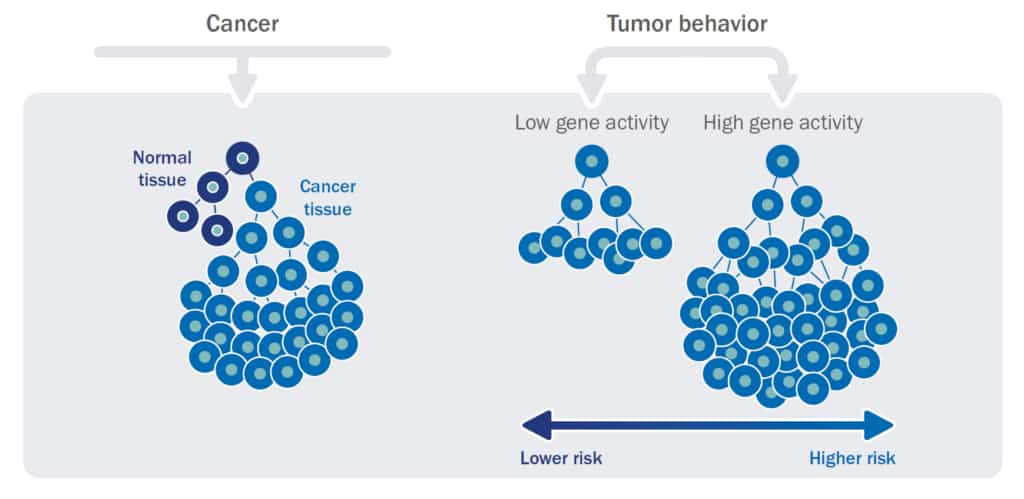
By analyzing the activity of specific genes involved in cancer cell growth, Prolaris provides insight into how quickly your cancer is likely to grow and spread. This information reflects the biological behavior of your tumor.
This genomic result is combined with established clinicopathological factors – including your PSA level, Gleason score, and tumor stage – to provide a more complete and personalized assessment of your individual risk of cancer progression.1-5
Genes
Genes are small sections of DNA, the material in your cells that carry your hereditary information and the instructions for how your cells work. The activity of some of these genes in your tumor cells can influence how quickly cancer grows or spreads – and how it might respond to treatment.
Genomic Test
A genomic test measures the activity of specific genes in a tumor. It helps to understand how the cancer behaves. This is different from a genetic test, which looks for inherited changes in the DNA sequence that may increase risk of developing cancer.
How Prolaris Helps
Not all prostate cancers behave the same way. Some grow very slowly and may never cause harm, while others are more aggressive and require early treatment. Traditional clinical tools are essential, but they cannot always fully predict how an individual cancer will behave.
Prolaris helps answer questions that matter most to patients:
- How aggressive is my prostate cancer?
- Is active surveillance an option for me?
- Would additional treatment improve my long-term outlook?
By combining genomic information with clinical factors, Prolaris provides a personalized risk estimate to support shared decision-making between you and your doctor.1-5
Prolaris Test results have led to changes in prostate cancer management in up to 65% of patients.6
Is the Prolaris Test Right for Me?
The Prolaris Test is performed before making any prostate cancer treatment decisions. Many untreated patients diagnosed with localized prostate cancer are candidates for Prolaris Testing, including those who are:
- Newly diagnosed
- Currently on active surveillance
The Prolaris Test provides individualized information about your specific cancer to help you and your doctor make informed and confident decisions about the treatment pathway that’s right for you.

Prolaris®
Four Steps to Your Result
Talk to
your doctor
The test can be requested from one of the performing pathology labs.
Your existing tumor sample is used
The test is performed in a certified lab
Results in about one week

Understanding Your Test Result
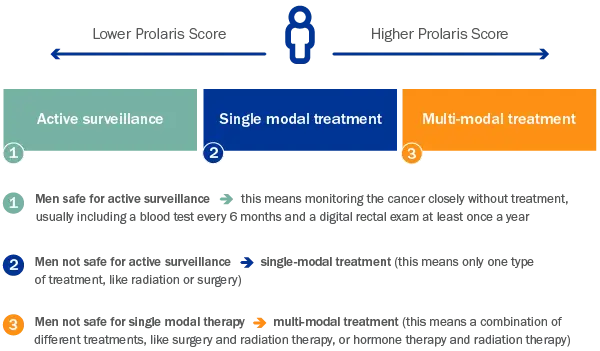
Your Prolaris result is presented as a clear, personalized risk estimate. It helps your doctor assess:
- Your risk if the cancer is managed conservatively (e.g. active surveillance)1-3
- Your risk after single treatment, and whether additional therapy may be beneficial4,5
Rather than placing you into a general classification, the result reflects your unique situation.

Personalized Decisions
Prolaris does not make decisions for you – but it gives you and your doctor clearer information to make decisions together. The test result shows the risk of your prostate cancer getting worse within 10 years. For many patients, this means less uncertainty, greater confidence, and a treatment plan that truly fits their life.
Ask your doctor whether Prolaris could help guide your prostate cancer care.

Want to Learn More at Your Own Pace?
- All essential Prolaris information in one brochure.
- Easy to read and revisit.
- Download to learn about your options.
References
- Lin DW, et al. Identification of men with low-risk biopsy-confirmed prostate cancer as candidates for active surveillance. Urol. Oncol. 2018
- Cuzick J, et al. Prognostic value of a cell cycle progression signature for prostate cancer death in a conservatively managed needle biopsy cohort. Br J Cancer. 2012
- Cuzick J, et al. Validation of an RNA cell cycle progression score for predicting death from prostate cancer in a conservatively managedneedle biopsy cohort. Br J Cancer. 2015
- Tward JD, et al. Personalizing localized prostate cancer: Validation of a combined clinical cell-cycle risk (CCR) score threshold for prognosticating benefit from multimodality therapy. Clin Genitourin Cancer. 2021
- Tward JD, et al. The clinical cell-cycle risk (CCR) score is associated with metastasis after radiation therapy and provides guidance on when to forgo combined androgen deprivation therapy with dose-escalated radiation. Int J Radiat Oncol Biol Phys. 2022
- Crawford ED. Et al.: Cell Cycle Progression Score and Treatment Decisions in Prostate Cancer: Results From an Ongoing Registry. Curr Med Res Opin 2014
 English (UK)
  Français
  Italiano
  Español
  Deutsch