

Gain Clarity in Prostate Cancer Treatment
Prolaris provides insight into prostate cancer aggressiveness to support
treatment decisions.1-5
How to Predict Progression in Localized Prostate Cancer
Choosing the right treatment for localized prostate cancer can be complex. Deciding whether active surveillance is appropriate or whether more intensive treatment is needed is not always straightforward. While established clinical factors remain essential, they may not fully capture the biological behavior of an individual tumor.
Prolaris is a prognostic test for localized (non-metastatic) prostate cancer. By analyzing tumor biology, it helps estimate the risk of disease progression. The test provides information on the 10-year risk of prostate cancer–specific mortality in conservatively managed patients and the 10-year risk of metastasis following definitive treatment.1-5
This adds powerful information to standard assessments, enabling treatment plans that are both effective and quality-of-life focused – helping to avoid under- and overtreatment as well as possible side effects.

A Proven Decision-Making Tool for Prostate Cancer
-
Traditional risk tools (such as Gleason score, PSA, and clinical stage) provide important first insights but have specific limitations and cannot fully capture the biological aggressiveness of the cancer.6-8
Moreover, guideline-based risk groups defined by clinical-pathological factors often span a broad spectrum of treatment options, making precise decision-making challenging.9-11
Prolaris adds unique prognostic insight from the tumor’s genomic activity, validated in multiple clinical studies with about 10.000 patients, to improve risk stratification and treatment decisions.12
Prolaris®: Comprehensive Risk Assessment
Prolaris is a genomic test that analyzes the activity of Cell Cycle Progression (CCP) genes in prostate tumor tissue. By combining this molecular score with key clinical-pathological factors (CAPRA-Score), Prolaris predicts disease-specific mortality and metastasis risk in localized prostate cancer, offering actionable, objective guidance for personalized treatment planning.1-5
Providing Clear Answers to Critical Treatment Questions
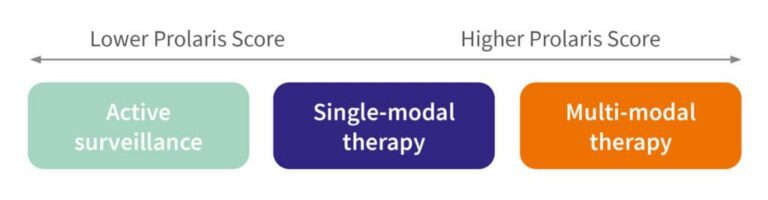
Is active surveillance (AS) an option?
Prolaris predicts the 10-year probability of disease-specific mortality under conservative management, supporting informed decisions on which patients may opt for active surveillance to avoid overtreatment and which may benefit from active treatment (e.g. single-modal therapy).1-3
Should the treatment be intensified?
By estimating the 10-year probability of metastasis after definitive therapy, Prolaris helps guide decisions on whether additional treatment (multi-modal therapy), is needed to ensure appropriate intervention.4-5
How Prolaris® Helps You
Understand the probability of your cancer developing – so you can choose the right care plan with confidence and peace of mind.
Support your recommendations with an objective, evidence-based tool that integrates molecular and clinical data for precise risk assessment.
Integrate Prolaris into your workflow with reliable results and rapid turnaround time.

Prolaris® Testing – Fast, Comprehensive, Actionable
Outside the US, the Prolaris prostate cancer prognostic test is available as a validated CE-marked in vitro diagnostic (IVD) test.13
Prolaris can be performed in local molecular pathology laboratories, with results typically available within a few days.
Fast turnaround time
Combining molecular tumor biology and clinical factors
Performed in local labs
How to Access Prolaris®
Clinicians & Pathologists
Local Testing with Prolaris
References
Lin DW, et al. Identification of men with low-risk biopsy-confirmed prostate cancer as candidates for active surveillance. Urol. Oncol. 2018
Cuzick J, et al. Prognostic value of a cell cycle progression signature for prostate cancer death in a conservatively managed needle biopsy cohort. Br J Cancer. 2012
Cuzick J, et al. Validation of an RNA cell cycle progression score for predicting death from prostate cancer in a conservatively managedneedle biopsy cohort. Br J Cancer. 2015
Tward JD, et al. Personalizing localized prostate cancer: Validation of a combined clinical cell-cycle risk (CCR) score threshold for prognosticating benefit from multimodality therapy. Clin Genitourin Cancer. 2021
Tward JD, et al. The clinical cell-cycle risk (CCR) score is associated with metastasis after radiation therapy and provides guidance on when to forgo combined androgen deprivation therapy with dose-escalated radiation. Int J Radiat Oncol Biol Phys. 2022
Allsbrook WC et al. Interobserver reproducibility of Gleason grading of prostatic carcinoma: Urologic pathologists. Hum. Pathol. 2001
Schreiber D, et al. Prostate biopsy concordance in a large population-based sample: a Surveillance, Epidemiology and End Results study. J. Clin. Pathol. 2015
Oshikiri T, et al. Prognosis of patients with prostate cancer and middle range PSA levels (20–100 ng/mL): When PSA reaches approximately 70 ng/mL, prognosis may plateau. Int Braz J Urol. 2016
EAU guidelines on Prostate Cancer 2025
ASCO: Molecular Biomarkers in Localized Prostate Cancer 2019
NCCN Clinical Practice Guidelines in Oncology (NCCN Guidelines®) for Prostate Cancer V.3.2025
- https://prolaris.com/posters-and-medical-publications/#!#home
Prolaris® for QuantStudio™ 5 Dx Instruction Manual Version EN/04 2025
 English (UK)
  Français
  Italiano
  Español
  Deutsch