
Eurobio Oncology
Prolaris®: Pathologists

Reliable Precision – Either in Your Lab or Through Our Partner Laboratories
Prolaris offers fast, clinically validated, prostate cancer risk assessment with full support, wherever the test is performed.
Assessing Risk of Prostate Cancer Progression
- Prolaris is a proven gene expression test for assessing personalized risk in prostate cancer, combining molecular data with clinical factors to deliver precise prognostic information. Supported by strong clinical evidence, Prolaris helps guide treatment decisions to avoid over- and undertreatment and improve patient outcomes.1-5
Available as a CE-marked IVD kit for qualified pathology labs, Prolaris can be performed locally or accessed through our partner labs – ensuring quick, reliable results for clinicians and patients alike.6,7
The only Genomic Prostate Cancer Test Available as a Kit
Centralized testing can create barriers, and more countries now prefer in vitro diagnostic testing to be performed locally. To address this, Myriad Genetics developed the Prolaris Kit: a solution enabling decentralized testing for men with prostate cancer.6 Eurobio Scientific holds the license to commercialize the kit, making it accessible to laboratories in regions where local testing is preferred or mandated.
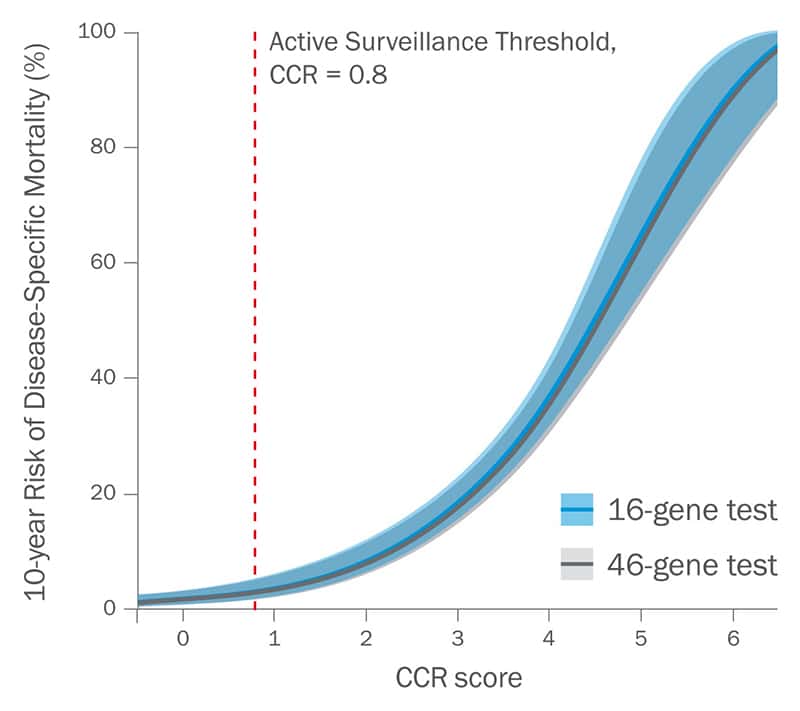
The kit features a streamlined 16-gene panel (10 cell cycle progression genes and 6 housekeeping genes), derived from the original 46-gene signature. Validation studies confirmed a very high correlation (r = 0.97) with the original test, demonstrating equivalent performance.7
Reanalysis of clinical prostate cancer cohorts further showed that the 16-gene Prolaris Kit delivers a Clinical Cell Cycle Risk (CCR) score that remains a strong predictor of 10-year disease-specific mortality – directly comparable to the original 46-gene test.7
Precision Insights for Personalized Prostate Cancer Care
Prolaris is a genomic test, validated in about 10.000 patients across all risk groups, that pathologists can offer to guide individualized treatment planning for men with prostate cancer.8
Clinicians rely on Prolaris for its robust prognostic performance, helping identify patients’ risk and supporting informed therapy decisions – impacting treatment choices in up to 65% of patients.9
With a turnaround time of approximately 8 hours, the test fits easily into molecular lab workflows while ensuring fast delivery of results to treating physicians and the multi-disciplinary team.
of patients tested with the Prolaris Test had a change in their treatment plan9

Independence is Good, but Comprehensive is Better
Second generation testing
As a second-generation test Prolaris delivers more than genomic information. By combining the independent CCP score with established clinical features, it provides the most comprehensive prognostic assessment available.
- 10-Gene Molecular Score – CCP is an independent predictor of prostate cancer outcome10
- Clinicopathological Factors – Prolaris integrates CAPRA score directly into the result3
- CE-IVD Kit for Local Testing – Enables fast turnaround time and lab-controlled quality within molecular pathology workflows
What the Prolaris result reveals
- Individual 10-year risk of prostate disease-specific-mortality when conservatively managed1-3
- Individual 10-year metastasis risk after definitive therapy4,5
Based on these results, Prolaris helps clinicians to determine which men with localized prostate cancer are suitable for active surveillance and which need active treatment, while also guiding decisions between single-modal and multimodal therapy.1-5
Results are presented in a clear, user-friendly format, including visual thresholds and patient-oriented summaries, helping clinicians communicate risks effectively and support shared decision-making.
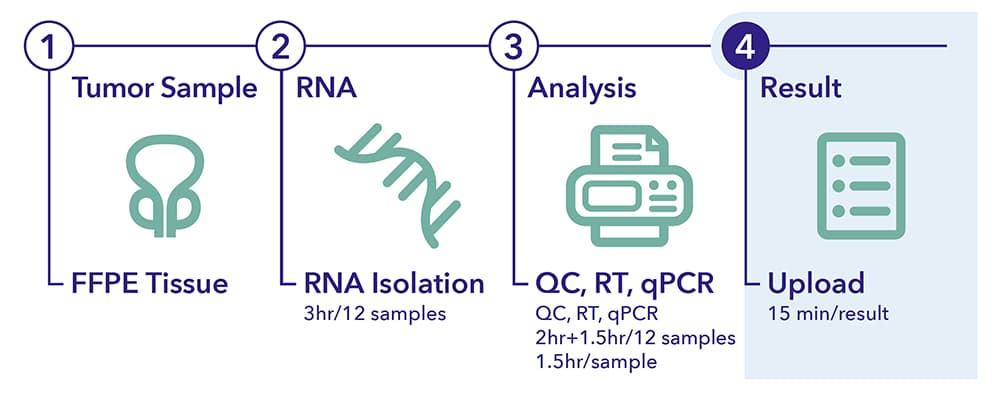
How to Perform the Prolaris® Test
1. Sampling6
Prolaris is performed on FFPE tumor tissue from treatment-naïve localized prostate cancer biopsy.
- Tumor size: A minimum of 0.5 mm linear tumor
- Tumor content: Minimum of 60% tumor content in the sample
- Accepted formats: FFPE tumor block preferred. If the block cannot be sent, one H&E cut at 4-5 microns, plus five consecutive unstained 5-micron sections are required
- Storage and shipping: Store and ship specimens at room temperature
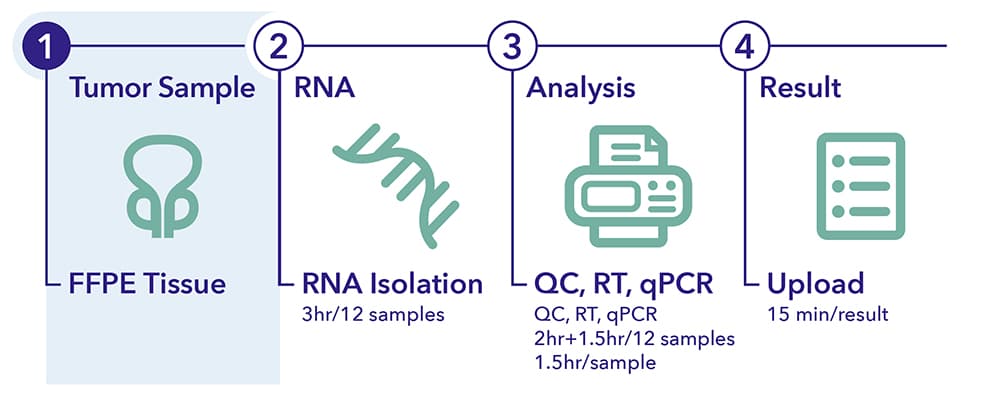
2. RNA Extraction6
RNA extraction can be performed manually or semi-automatically from macro-dissected prostate cancer biopsy, with a turnaround time of 3 hours per 12 samples. The following RNA extractio kit and reagents are validated for use:
- QIAGEN® miRNeasy® FFPE Kit (used with QIAGEN® Deparaffinization Solution)
Semi-automatically RNA extraction using the QIAcube is possible.
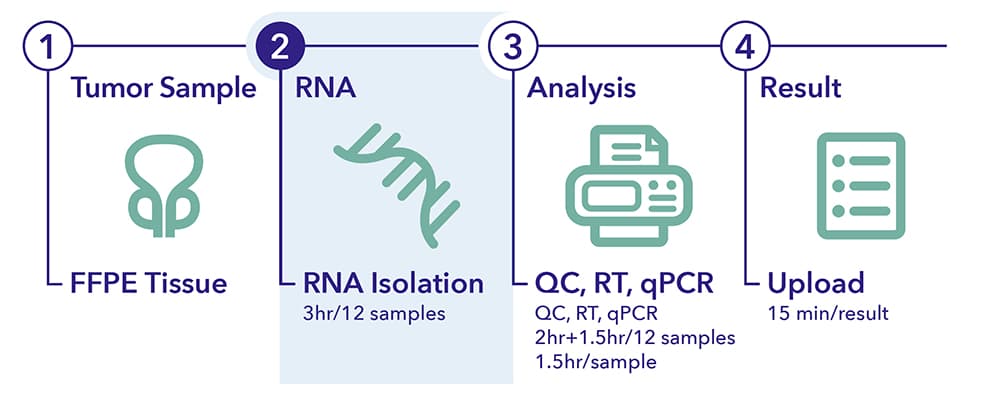
3. Analysis6
The Prolaris Kit may only be used together with the QuantStudio™ 5 Dx Real-Time PCR Instrument from Thermo Fisher Scientific®.
Quality control
- Single step RT-qPCR: Turnaround time 2 hours per 12 samples.
Final analysis
- Reverse transcription and pre-amplification: Turnaround time 1.5 hours per 12 samples.
- Quantitative PCR: Turnaround time 1.5 hours per sample.
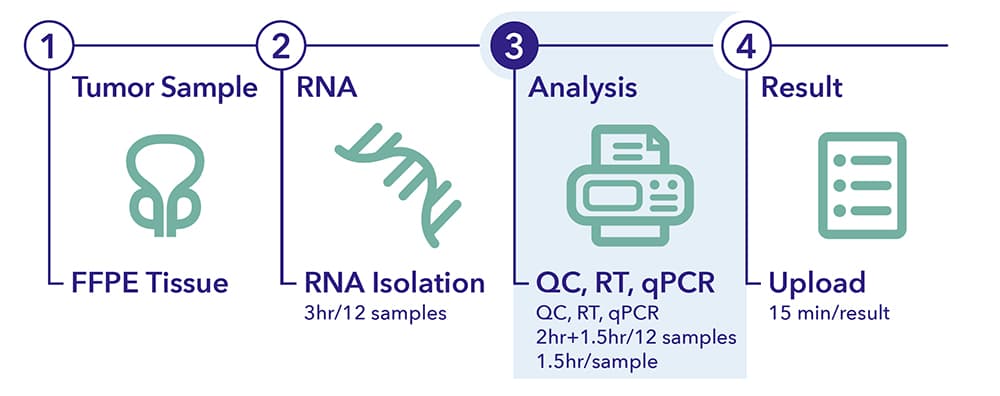
4. Result6
The result report (including quality control) is generated using a web-based software, the Prolaris® Biopsy Report Generator (PPRG).
- The reports are generated in less than 15 minutes.
Not yet a partner lab? You can try it out yourself by generating a sample report using the Prolaris® Report Generator and the demo data files available in the download section of the PPRG.
How to Order a Prolaris® Test
Outside the US, Prolaris prostate cancer prognostic test is performed in certified local laboratories, delivering reliable results within just one week.
Physicians can conveniently order Prolaris through performing laboratories.
Use the link below to find a lab and place your order. Have questions? Contact us anytime – we’re here to help.
How to Order a Prolaris® Kit
Pathologists who are already trained and qualified to run Prolaris in their own laboratory can order kits directly.
Please note: kits are available exclusively for laboratories with established implementation and trained personnel.

Get the Prolaris® Test in Your Lab
Prolaris is available as a CE-marked IVD kit that can be run in local molecular pathology laboratories after comprehensive onsite training, provided by Eurobio Scientific.
Interested in offering Prolaris in your lab?
References
. Lin DW, et al. Identification of men with low-risk biopsy-confirmed prostate cancer as candidates for active surveillance. Urol. Oncol. 2018
Cuzick J, et al. Prognostic value of a cell cycle progression signature for prostate cancer death in a conservatively managed needle biopsy cohort. Br J Cancer. 2012
Cuzick J, et al. Validation of an RNA cell cycle progression score for predicting death from prostate cancer in a conservatively managedneedle biopsy cohort. Br J Cancer. 2015
Tward JD, et al. Personalizing localized prostate cancer: Validation of a combined clinical cell-cycle risk (CCR) score threshold for prognosticating benefit from multimodality therapy. Clin Genitourin Cancer. 2021
Tward JD, et al. The clinical cell-cycle risk (CCR) score is associated with metastasis after radiation therapy and provides guidance on when to forgo combined androgen deprivation therapy with dose-escalated radiation. Int J Radiat Oncol Biol Phys. 2022
Prolaris® for QuantStudio™ 5 Dx Instruction Manual Version EN/04 2025
Kuhl V, et al. Development and validation of a cell cycle progression signature for decentralized testing of men with prostate cancer. Biomarkers in Medcine. 2022
- Scientific Publications | Myriad Genetics
Crawford ED. Et al.: Cell Cycle Progression Score and Treatment Decisions in Prostate Cancer: Results From an Ongoing Registry. Curr Med Res Opin 2014
Cuzick J, et al. Prognostic value of an RNA expression signature derived from cell cycle proliferation genes in patients with prostate cancer: a retrospective study. Lancet Oncol. 2011
 English (UK)
  Français
  Italiano
  Español
  Deutsch